

Five years have passed since the Taliban returned to power, during which restrictions on women’s education, employment and public participation have progressively expanded. Women’s rights advocates and international officials now say solidarity alone is insufficient. Afghan women must genuinely participate in decisions about their country’s future, and international support must move towards action, accountability and justice.
On 20 October, the UN Office for Partnerships reported on a meeting focused on Afghan women and girls. Organised with Ireland and the Malala Fund and supported by several other countries, it asked a fundamental question: five years after the Taliban’s return, what should genuine solidarity mean?
The response went beyond concern. Speakers emphasised continued humanitarian support, meaningful political participation by Afghan women and effective accountability for rights violations.
Five years of restrictions: from schools and universities to employment and public life
Since August 2021, restrictions on Afghan women and girls have become a major global human rights issue. Women have been excluded from many jobs and public activities, girls denied secondary education and women barred from universities.
UN Women data records more than 100 decrees and directives affecting women’s and girls’ rights over five years. Restrictions extend beyond education to work, justice, healthcare, movement and public spaces.
Their daily effects are clear. More than half of surveyed women said they left home twice a month or less. Nearly three-quarters felt unsafe leaving without a male companion or mahram.
The issue therefore goes beyond formal bans on study or employment: everyday space for women’s lives has progressively narrowed.
A generation of girls excluded from education
Afghanistan remains the only country systematically denying girls secondary education and women university access, one of the deepest consequences of the past five years.
The effects extend into the future. Without a generation of female university students, Afghanistan will face shortages of women teachers, doctors, nurses, midwives and other professionals.
Citing new estimates, UN Women warns that continued restrictions could cost Afghanistan more than 25,000 female teachers and health workers by 2030.
This creates a dangerous cycle. With fewer female health professionals and restrictions on women consulting men, access to healthcare becomes harder.
Women’s silent mental health crisis
UN Women reports a serious mental health crisis among women and girls, beyond the restrictions’ economic and educational consequences.
According to its data, seven in ten women described their mental health as bad or very bad. Exclusion from work and education, fewer social connections, restricted movement, uncertainty and prolonged confinement at home can intensify distress.
Afghanistan also has one of the world’s highest maternal mortality rates. Restricted healthcare access and a growing shortage of female staff raise further concerns.
Excluding women costs the economy as well as human rights
Women’s exclusion from employment directly affects Afghanistan’s economy.
Data cited by UN Women indicates only around 7 per cent of women participate in the labour force, compared with approximately 84 per cent of men . Continued social and economic exclusion is estimated to cost the economy around $920 million, equivalent to 5.8 per cent of GDP, between 2024 and 2026.
Women’s rights cannot be separated from the economic future. Denying half the population education, work and participation discards a vast share of human capital.
Despite restrictions, women have not fallen silent
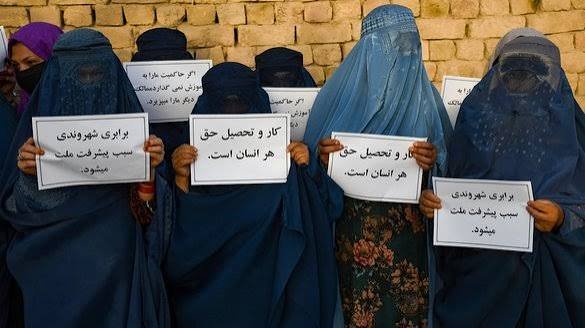
Afghan women’s story is not solely one of deprivation. The October UN meeting also highlighted their resistance and continued work .
Inside and outside Afghanistan, women continue education, healthcare, social support, advocacy and assistance to others. Women-led organisations are among the few networks providing essential services in many areas, including protection from violence and physical and mental healthcare.
These organisations also face financial crisis. UN Women reported that nearly three-quarters surveyed in Afghanistan experienced funding cuts in 2025, and more than half expected to suspend or close operations within a year if conditions continued.
Cuts to international assistance may therefore weaken one of the last remaining support networks for Afghan women, rather than simply organisational budgets.
Afghan women must participate in decisions about their future
A clear message was that Afghanistan’s future cannot be decided while excluding its women from the table.
Ireland’s Minister for Foreign Affairs and Trade, Helen McEntee, stressed continued engagement and humanitarian assistance, with Afghan women’s voices central to the response. Malala Yousafzai warned against normalising relations with the Taliban and insisted that women participate in decisions about their future.
UN High Commissioner for Human Rights Volker Türk and Afghanistan Accountability Collective founder Mitra Mehran also emphasised accountability and women’s real, meaningful participation in political processes.
From symbolic solidarity to accountability
After five years, a major shift in international discussion may be the recognition that solidarity alone is insufficient.
Statements, campaigns and diplomatic condemnations can maintain attention, but how does support produce practical outcomes for women inside Afghanistan?
The UN meeting stressed that solidarity must involve sustained action, meaningful women’s participation and commitment to justice and accountability .
Women’s rights must not become a secondary political issue, and international engagement must not normalise the restrictions.
The danger of normalising an abnormal situation
UN Women identifies normalisation of Afghan women’s conditions as a major concern five years after the Taliban’s return.
A crisis lasting years risks losing media, government and public attention. An initial emergency can gradually be accepted as everyday reality.
But denying millions of girls education, excluding women from universities and much employment, and restricting public participation must not be accepted simply as Afghanistan’s current conditions.
The UN Office for Partnerships’ 20 October report summarised the message: Afghan women and girls must remain central to decisions about the country’s future, and their rights must stay on the global agenda.
Afghanistan’s future cannot be built without women
The question after five years is no longer simply whether the world expresses solidarity, but what that solidarity achieves.
Will women participate in negotiations? Will women-led organisations receive resources to continue? Will restrictions on girls’ education and women’s work carry political and legal costs? Will perpetrators face genuine accountability?
These questions determine whether supporting Afghan women remains a slogan or becomes practical policy.
Women have shown that restrictions have not silenced them. The international community’s responsibility is not to speak in their place, but to create space for Afghan women to speak about their country’s future, participate in decisions and ensure their rights are not sacrificed in political deals.
Five years after the Taliban’s return, the message is clear: Without Afghan women’s participation, Afghanistan cannot have an inclusive, sustainable future.
Sources: UN Office for Partnerships, UN Women and official United Nations sources.