

Australia’s housing crisis has entered a more worrying phase. The latest data shows that more than six in ten homelessness service providers must now turn away people they could previously assist. Rising demand is not the only problem. Many services say they have nowhere to move people into. Emergency accommodation is limited, suitable rentals are hard to find and social housing waits are long. The system intended to prevent homelessness is itself under severe pressure.
On 28 October 2026, Homelessness Australia warned that separate housing and homelessness problems had developed into a broader crisis. In a report informing the federal government’s mid-year budget outlook, it drew on new findings from the Australian Homelessness Monitor 2026 by UNSW’s City Futures Research Centre and Australian Institute of Health and Welfare data. The picture is complex: demand has risen, finding housing has become harder and many services have reached capacity.
More than six in ten providers must turn people away
One major new finding is that 63 per cent of homelessness service providers say they must now turn away people they could previously help. Some said the number turned away was at least as large as the number receiving support.
The main issue is not simply a lack of shelter beds. A person entering emergency accommodation is eventually meant to move into stable housing. If suitable housing is unavailable, they stay longer. No vacancy opens up, leaving the next person needing help outside.
Pressure therefore spreads through the system. A shortage of long-term housing burdens temporary accommodation. When temporary accommodation fills, services cannot accept new people.
91 per cent of providers say demand has increased
Changes in demand reveal the extent of this pressure. 91 per cent of service providers said demand had increased over the previous two years, while only 0.4 per cent reported a decline.
Meanwhile, 86 per cent said finding long-term housing for clients had become harder than two years earlier. Seventy per cent described it as “much harder”. Fewer than one per cent said it had become easier.
These figures show that the problem goes beyond service management. Even where a provider can support someone, the next step—finding a stable home—has become a major barrier.
Only 3.9 per cent of those needing long-term housing received it
One of the most troubling figures concerns access to stable housing.
Citing AIHW data, Homelessness Australia says that among clients needing long-term housing , only 3.9 per cent received that form of accommodation.
This explains why emergency services struggle. If people entering the system have no pathway into stable housing, it gradually becomes blocked.
Workers may be able to offer food, counselling or short-term support, while the person’s central need remains unmet: a safe, stable home.
Some services say they can offer nothing but tents
The severity of the crisis is visible in frontline workers’ experiences as well as statistics.
In research cited by Homelessness Australia, one service representative said workers sometimes had nothing to offer except a tent and advice on safer camping locations. For some women fleeing family violence, support had reached the point of asking whether their car could be locked.
These examples show how limited assistance has become in some cases. Without emergency housing or safe accommodation, services may be able only to reduce the dangers of living without shelter rather than move people into housing.
This is particularly important for women and children fleeing family violence. Leaving a violent relationship becomes much harder when someone does not know where they will sleep the next night.
The rental crisis is a major driver
According to the research, 92 per cent of service providers identified worsening rental affordability as a factor driving increased demand for homelessness services.
This connection matters. Homelessness does not always begin with a sudden event. A family may struggle for months to pay rent, first cutting recreation and non-essential purchases, then food quality, using savings and borrowing from friends or relatives. If rent keeps rising or income falls, the gap between income and housing costs eventually becomes unmanageable.
At that point, even a small event can trigger a crisis. Job loss, illness, separation, reduced working hours or a major unexpected expense can upset the financial balance.
Homelessness cannot therefore be considered separately from housing affordability.
Homelessness does not always mean sleeping on the street
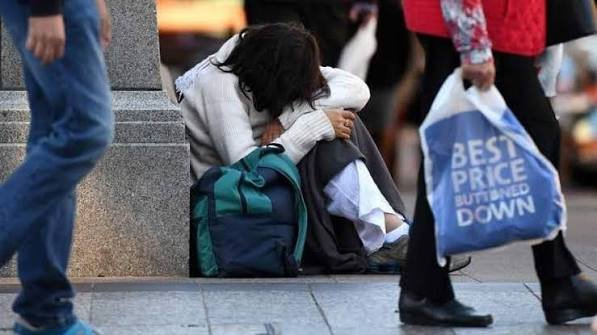
Many people picture someone sleeping on a footpath or in a park. However, much homelessness in Australia is not visible in this way.
People may live in emergency accommodation, move between friends’ and relatives’ homes or sleep in cars. A family may move from one temporary place to another every few weeks.
According to the 2021 Census, still the latest complete census on this issue, 122,494 people were experiencing homelessness in Australia on census night. Only around 6.2 per cent were sleeping rough. A much larger share experienced other forms of homelessness or highly insecure housing.
This distinction matters. Someone may have somewhere to sleep each night yet still lack a safe and stable home.
Hundreds of thousands of requests for help also go unmet
Pressure on the system appears in more than one survey.
AIHW data also reported by ABC shows that nearly 289,000 people received help from specialist homelessness services in 2024–25. During the same period, however, around 370,000 requests for assistance went unmet or could not be provided with the services requested.
This does not mean 370,000 separate individuals, since one person may request help more than once. Nevertheless, the volume of unmet requests shows a substantial gap between community needs and service capacity.
Canberra is not outside this crisis
For ACT readers, it is inaccurate to assume homelessness is mainly a problem for larger cities such as Sydney and Melbourne.
Canberra homelessness services reported rising demand for food, housing and essentials in 2026. In August, ABC reported that homelessness had become more visible despite the city’s relatively high incomes. Local services also described pressure from long public housing waits and a lack of affordable options.
Young people in the ACT are vulnerable too. ACT Shelter said that, over one year, nearly 700 young people sought homelessness support, with fewer than half accessing housing. Nearly half were turned away without housing or an appropriate referral.
Homelessness in the capital can therefore be hidden. Someone may live in a car, stay temporarily with friends or change accommodation every few weeks.
Women fleeing family violence face greater risks
Housing and family violence are closely connected.
Someone wanting to leave a violent relationship needs a safe place. If emergency accommodation is full and private rent is unaffordable, their choices become severely limited.
This can leave some women in unsafe relationships longer or facing homelessness after leaving. Service examples show capacity falling far short of demand in some areas. Hobart Women’s Shelter, for example, turned away 822 requests in one year because of limited capacity.
Expanding crisis and transitional accommodation for women and children fleeing violence is therefore an important part of homelessness policy.
Service workers are also under pressure
The crisis affects staff as well as people seeking help.
In the new research, 69 per cent of providers identified staff burnout and turnover as major consequences of growing demand. Fifty-eight per cent also said their work had become too focused on immediate crisis responses rather than preventing homelessness.
This shift matters. Prevention is usually easier and less costly than helping someone who has already lost their home.
For example, short-term help with rent arrears or negotiations to preserve a tenancy may prevent a family becoming homeless. Once they lose their home, finding new housing, emergency accommodation and other support can be much harder and more expensive.
When workers spend all their time on immediate crises, less time remains for these preventive measures.
Why does this matter to migrant families?
Being a migrant does not itself mean being at risk of homelessness. Some newcomers, however, may face additional vulnerabilities as they begin life in Australia.
They may lack an Australian rental history or have a small family network. They may not yet have stable employment or may work below their skill level. Some may also lack information about tenancy rights, financial support or local services.
If such a family suddenly faces higher rent, job loss or family violence, a limited support network can make matters harder.
Knowing available services and seeking assistance before losing a home is therefore important. Homelessness does not usually happen in one day. Signs of financial pressure and difficulty paying rent often appear earlier.
What is Homelessness Australia calling for?
Homelessness Australia says small, scattered measures are no longer sufficient. It has called on the federal government to substantially increase investment in social housing and homelessness services.
Its proposals include building 34,000 social homes each year so social housing reaches six per cent of all Australian housing by 2040. It also proposes higher income support payments, more service funding, 20,000 Housing First and supportive housing places, and greater investment in prevention.
These are Homelessness Australia’s proposals, not adopted government policies. Advocacy requests must be distinguished from official decisions.
When services must say “we have no room”
Perhaps the most concerning aspect is not the homelessness figure itself, but that the support system can no longer respond in many cases.
People losing their homes often seek help at their most vulnerable. Being told there are no beds, no available homes and long waiting lists deepens their crisis.
The latest data shows Australia faces more than a problem of individuals experiencing homelessness. It faces a shortage of affordable homes, rental market pressure, insufficient social housing and services whose staffing and capacity do not match demand.
Building more homes is therefore only part of the response. Social housing, emergency accommodation, support for women fleeing violence, youth services and interventions before people lose their homes also matter.
When more than six in ten providers say they must turn away people they could previously assist, this is more than a crisis for a few individuals or families. It signals pressure across an entire system.
Perhaps the most important warning is this: the later help arrives, the harder it becomes to move someone from homelessness into a safe, stable life.
Sources: Homelessness Australia, the Australian Homelessness Monitor 2026 from UNSW City Futures Research Centre, the Australian Institute of Health and Welfare, and ABC News reporting.